Sell-stage examples
Every Sell-stage asset in the gallery, shown with the handoffs into and out of it.
96 examples
- Acquisition.com — "Before You Check Your Email" — the workshop pitchOne line confirms the roadmap is on its way; everything else is the pitch. A video sales letter for the two-day Las Vegas workshop ("we're selecting only 100 businesses"), a "See If I'm a Fit" button, and then an iClosed booking widget with a countdown ("Book Your Call in 9s"). The note under it — "This call is NOT required to receive your Scaling Roadmap" — is the pressure valve, and the footnote gives the price: a $5k ticket, travel not included. Below the fold is a wall of 150 Google reviews (4.9, "98% recommend") that makes the page nearly 48,000px tall on mobile. The heading is personalised: a $1M–$3M answer reads "You're Ready to Scale", a $3M–$10M answer "You're Stage 4: Prioritize". The booking widget loads from a HubSpot preview URL (hubspotpreview-na1.com, inpageEditorUI=true), the editor version of the embed rather than the published one.View asset →


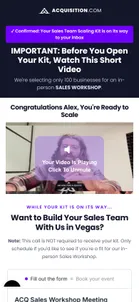
- Acquisition.com — "Before you open your kit" — the Sales Workshop pitchThe kit is confirmed in one line and then the page turns into a pitch: "Before you open your kit, watch this short video", "We're selecting only 100 businesses for an in-person SALES WORKSHOP". A note from Alex plays on a video, and a booking widget, iClosed event acq-sales-workshop-meeting-scaling-kit, follows under "Want to build your sales team with us in Vegas?". "This call is NOT required to receive your kit" is the pressure valve. The page greets the lead by first name ("Congratulations Alex, you're ready to scale"), which is how the ad's promised "link to schedule a call on the thank-you page" shows up.View asset →
- Acquisition.com — "Before You Check Your Email" workshop pitchThe confirmation that the frameworks are on their way is one line at the top; the rest of the page is a video sales letter for a 2-day in-person workshop in Las Vegas, with "we're selecting only 100 businesses", testimonials, and a booking widget. The promised lead magnet has not arrived yet — the pitch is deliberately placed in the gap before the email lands, which is what the headline "Before You Check Your Email" is buying.View asset →

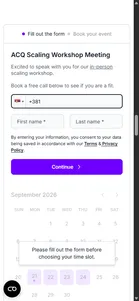
- Acquisition.com — Workshop fit-check bookingThe gate between a qualified lead and a sales call. iClosed asks for the phone number first and the name second, and the calendar sits right underneath it, fully drawn and entirely locked: the next four days are live, every other date is disabled, and both month arrows are dead until the form is filled. So the widget shows you that slots exist without letting you see how many or how far out — enough availability to feel real, not enough to shop around. "Please fill out the form before choosing your time slot" is the only instruction on the screen. Everything earlier in this funnel asked for an answer; this is the first screen that asks for a way to be called. The time-slot list behind Continue is not captured — reaching it puts a live phone number into a sales dialler.View asset →
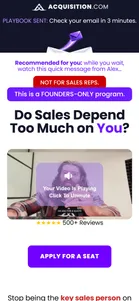
- Acquisition.com — "Founders-only" thank-you with booking"PLAYBOOK SENT: Check your email in 3 minutes." Then a red tag, "NOT FOR SALES REPS.", a purple one, "This is a FOUNDERS-ONLY program.", the headline "Do Sales Depend Too Much on You?" and a message from Alex on video, with an iClosed booking widget below. The page re-filters the audience after the form has already filtered it, by telling sales employees it is not for them.View asset →
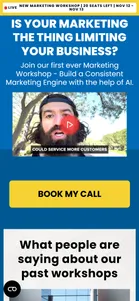
- Acquisition.com — Marketing Workshop pageA blue and yellow page, a different palette from the other two. The banner states the cohort and the seats left ("NEW MARKETING WORKSHOP | 20 SEATS LEFT | NOV 12 - NOV 13"), the headline is a question ("Is your marketing the thing limiting your business?"), and the button is the plainest of the set: BOOK MY CALL. Below the hero is "What people are saying about our past workshops".View asset →
- Acquisition.com — Sales Workshop pageThe same page is served from two hosts, lp.acquisition.com and www.acquisition.com. The headline names the audience instead of asking a question ("$1M+ Business Owners: Build a sales team that closes without you."), and the button asks for a seat instead of a call: "Apply for a seat". Underneath, "4.9 Google rating", "5,000+ founders attended · 80 seats per workshop", and "the operators who run sales across our $250M portfolio". The desktop banner says November and December are sold out and January 2027 is open.View asset →

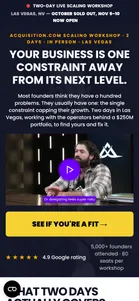
- Acquisition.com — Scaling Workshop page (/workshop-4b)/workshop redirects here, so the 6 ads that point at /workshop and the 9 that point at /workshop-4b land on one page. The headline is a promise ("Your business is one constraint away from its next level."), the body diagnoses ("they usually have one: the single constraint capping their growth"), and the button is a fit check, "SEE IF YOU'RE A FIT →". It carries the same Google-rating strip as the Sales page. The top bar says October is sold out and November 9–10 is open.View asset →
- Acquisition.com — Scaling Workshop page (/workshop-km)A second page for the same workshop, with the same video, reached by carousel ads. The headline is different, "Are you the thing limiting your business?", with "Remove yourself as the single point of failure" under it, and the button is I'M READY TO SCALE. It has no cohort banner and no Google-rating strip in the hero, and it books into a different calendar from /workshop-4b. Two pages for one offer on two calendars reads as a test of the page alone.View asset →

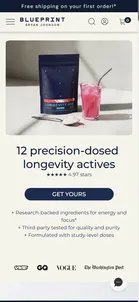
- Blueprint — Longevity Mix Actives — hero and benefitsAn 11,841px page that opens on "12 precision-dosed longevity actives" — a smaller number than the ad's "over 20", which is an unusual direction for a promise to move. Three proof bullets, a press wall (VICE, GQ, VOGUE, The Washington Post) and six benefit tiles that each name the active responsible, so the mechanism is stated rather than implied. "Trust data, not vibes" follows with two statistics, though one of them ("90% of adults don't get enough nutrients") sits a few screens from a second, unrelated 90% claim about supplement mislabeling.View asset →
- Blueprint — Clinically-backed ingredients + founder proofA swipeable carousel of thirteen actives, each with its own "Why we chose it:" line — the page's most substantial section, and the one doing the real work of justifying the price. It is followed immediately by "Bryan Johnson takes this daily", which tells the origin story as a simplification ("he was taking over 100 pills a day. To simplify the protocol, we packed 13 Longevity Actives into a daily drink"). Note the count drifting again: the hero says 12, this carousel holds 13.View asset →

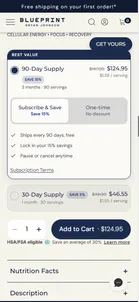
- Blueprint — The buy box — 90-day defaultThe funnel's entire mechanic. The 90-Day Supply is pre-selected and flagged BEST VALUE at $124.95 from $147.00 — "SAVE 15%", "$1.39 / serving" — with Subscribe & Save already chosen over "One-time · No discount". The 30-Day sits beneath it, unselected, at $46.55 and $1.55 / serving. Per-serving figures are printed under both prices, so the page performs the unit-cost comparison on the visitor's behalf, in the direction it wants. The striking part is what this costs relative to the brand's other funnel: the Protocol Quiz recommends this same product as the 30-day at 5% off — this page's consolation option. The colder the traffic, the deeper the discount.View asset →
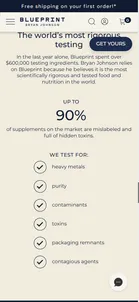
- Blueprint — "The world's most rigorous testing"Category-level fear, handled well: "UP TO 90% of supplements on the market are mislabeled and full of hidden toxins", answered with a spend figure ($600,000 on ingredient testing in the last year) and a six-item list of what is tested for. The framing is worth noting — "Bryan Johnson relies on Blueprint because he believes it is the most scientifically rigorous food and nutrition in the world" cites the owner of the company in the third person, as though he were an independent authority endorsing it.View asset →
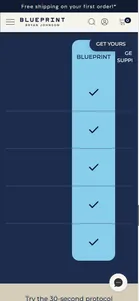
- Blueprint — "How We Measure Up" — broken on mobileA live defect worth studying, because it destroys the section on the exact surface the ads target. On desktop the table reads properly: five labelled rows — transparent third-party testing, consumed by Bryan Johnson, clinically-backed ingredients, study-level precision doses, no fillers — against two competitors. On mobile the entire label column is absent from the rendered table, and the table is 546px wide inside a 390px viewport with no scrollbar or visual hint that it scrolls. The mobile visitor's default view is a single column of checkmarks compared against nothing at all. Every ad in this set runs Facebook and Instagram placements.View asset →
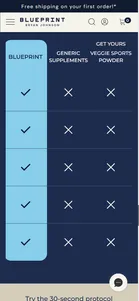
- Blueprint — The same table, swiped rightWhat the mobile visitor finds only by guessing that the table scrolls — two competitor columns of crosses, still with no row labels to say what is being compared. The sticky "GET YOURS" pill also lands on the "VEGGIE SPORTS POWDER" header. Included beside the default view because the pair is the finding: this is a persuasive asset that persuades nobody on the device it is served to.View asset →
- Blueprint — 30-second protocol, testimonial and FAQThe closing run — an ease-of-use section, one long first-person testimonial from a Verified Buyer, and a five-item FAQ covering contents, dosing, suitability, shipping and returns. Also the clearest view of a second defect: the sticky "GET YOURS" pill collides with the page's own inline "GET YOURS" button, rendering two overlapping copies of the same control.View asset →

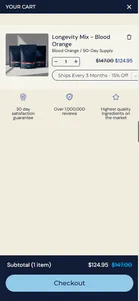
- Blueprint — Rebuy cart drawerThe subscription arrives pre-set to "Ships Every 3 Months - 15% Off" — a recurring quarterly commitment the visitor never explicitly chose, carried straight through from the buy box's default. A trust row (30-day satisfaction guarantee, over 1,000,000 reviews, highest quality ingredients) sits between the line item and the Checkout button, placing reassurance at the last decision rather than the first.View asset →
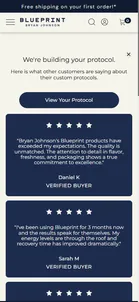
- Blueprint — "We're building your protocol."A processing screen that does no processing — the "View Your Protocol" button is live and clickable the instant it renders, with no progress bar or delay. Compare Heyflow, which fakes a calculating bar to make its recap feel earned. Blueprint wrote the copy for the mechanic and skipped the mechanic, so the screen functions as an interstitial ad for three testimonials that are generic, identical across personas, and unrelated to the answers just given.View asset →
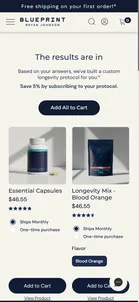
- Blueprint — "The results are in" — personalized protocolThe payoff, and the funnel's best and worst decisions in one screen. Best: the basket really is derived from the answers — two fixed flagship SKUs plus three slots driven by the goals question. Worst: every product renders with "Ships Monthly" pre-selected and "One-time purchase" unselected, and the price shown is the subscription price with the one-time price struck through beside it. The visitor never opts into a subscription; they opt out of a discount. "Add All to Cart" then carries five monthly shipments into the cart without a cadence ever having been chosen.View asset →
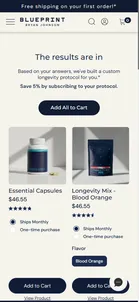
- Blueprint — The same screen, a different personaCaptured as evidence that the personalization is genuine rather than theater. A second persona — different age, sex, diet, format and goals — returned Essential Capsules and Longevity Mix again (the fixed core) but swapped the other three for Omega-3, Essential Microbiome and Metabolic Protein Powder, mapping legibly onto the gut and muscle goals it selected. Re-walking it from a clean context reproduced the identical five, so the rules are deterministic. It also lands $51.30 higher, entirely because the format answer pulled in a protein powder.View asset →
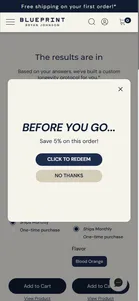
- Blueprint — "BEFORE YOU GO…" exit-intentAn abandonment offer that offers nothing new — "Save 5% on this order!" over a page whose subhead already reads "Save 5% by subscribing to your protocol" and whose five products already have the subscription pre-selected. The visitor is being interrupted and asked to accept a discount they have already been given. Worth including precisely because it is a common mistake dressed as best practice.View asset →
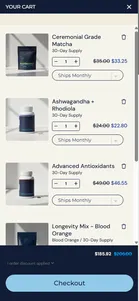
- Blueprint — Rebuy cart drawerEvery line arrives on "Ships Monthly" with a per-item cadence selector (one-time, 1, 2 or 3 months) the visitor never touched. The total is also lower than the results page implies: five products listed at $195.70 after the advertised 5% arrive as $185.92, labelled "1 order discount applied" — arithmetically a second 5% stacked on the first. Which promotion supplies it was not isolated, so treat the mechanism as unverified and the figures as captured.View asset →
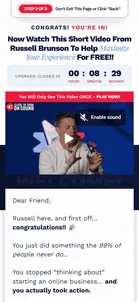
- ClickFunnels — "Upgrade to VIP for FREE", really a ClickFunnels trialThe page after registering says "STEP 2 OF 3", "CONGRATS! YOU'RE IN!" and "Don't Exit This Page". It offers a VIP Pass "normally $25,991+" for free, and almost all of that number is one line: "$25,000+" for a daily early session with Russell. Partway down, the letter says what the pass actually is: "A 14-Day Trial of ClickFunnels For FREE… After 14 days, it's $197/month". The card form at the bottom is a software trial sign-up. Two pressure devices sit on top of it. "You Will Only See This Video ONCE" is not true, because the same offer is back two clicks later. "Upgrade closes in 15:00" starts from fifteen minutes for every new visitor. It keeps counting down if you reload, but a new browser gets a fresh fifteen minutes. The decline link is written out in full as a confession: "No thanks, Russell. I understand this is my only chance… but I'd rather try to figure it out on my own without the tools."View asset →
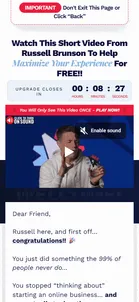
- ClickFunnels — The "only chance" offer, a second timeThe confirmation page's "Upgrade To VIP Now!" link opens the same letter, the same video and the same trial offer, with "Don't Exit This Page" in place of "Step 2 of 3", and a brand-new fifteen-minute timer. The page you declined an "only chance" on is here again one click after the thank-you page. The URL admits it.View asset →
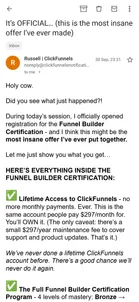
- ClickFunnels — The offer emails: one price, a growing stackThe offer is announced on the evening of Day 3, three days in, two days before the end. Email 09 names the price once: $5,500 for the Funnel Builder Certification, lifetime ClickFunnels and 50 agency accounts, plus $297 a year. That is the $997 deposit and $4,500 on the deposit page. It is framed against $5,346 for eighteen months of an ordinary account. From then on the price never moves and every email adds to the stack: an AI "Funnel Hacker Brain", Daily Draft ("$60K/year value"), six months of Rocketeer, Barnum PT Pro, CF Pro Tools upgraded "from 1 year to LIFETIME", until the finale email counts "13 bonuses… $5,500". The links carry utm_term=evergreen, the email list's own label for a launch that repeats.View asset →
- ClickFunnels — "Your lifetime ClickFunnels offer has almost expired" retargeting adWritten for people who sat through the challenge: "You crushed the One Comma Club Challenge..." The creative is Russell holding up the physical "Certified Funnel Builder" award, so the thing being sold is shown as a trophy before it is shown as software. The ad has run since April. That only works because the challenge repeats, and it runs on the same day as cold ads inviting strangers to the next one.View asset →

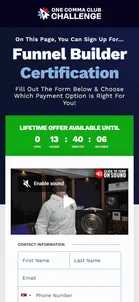
- ClickFunnels — Funnel Builder Certification, $997 depositThe sale the whole funnel leads to. You pay a $997 non-refundable deposit to "save your spot", and then either $4,500 in one payment or three payments of $1,800. "If you haven't selected a plan within 7 days, you will automatically be placed on the 3-pay option." The stack adds up to a claimed $343,722: lifetime ClickFunnels ($35,640, plus a $297-a-year maintenance fee), the certification ($14,997), 50 agency accounts and several bonuses. Unlike the upgrade page, this countdown is real: it showed the same time in two separate browsers. The form asks for your T-shirt size, because the certification comes with merchandise as well as the award.View asset →
- Dent Global — The KPI GamePlan strategy session (first screen only)"Apply for a free Strategy Session." One of Dent's "senior strategy advisors" will diagnose your bottlenecks and show you "how you can use our growth system in your business": the sales call for the accelerator. "Begin your 60-second application to book a call" takes a name and email, then the application. The KPI scorecard offers this call, as a 75-minute strategy session, only to visitors with $100k+ revenue who say they can invest. Whether workshop registrants are sent here was not seen. TODO: the application questions and the booking step.View asset →
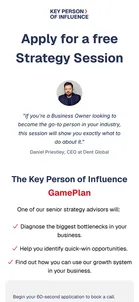
- Dent Global — KPI GamePlan strategy session“Apply for a free Strategy Session.” A senior strategy advisor will “diagnose the biggest bottlenecks in your business” and show “how you can use our growth system in your business”: the sales call for the accelerator. The scorecard result calls it 75 minutes. TODO: the application questions and the booking calendar sit behind an hCaptcha.View asset →
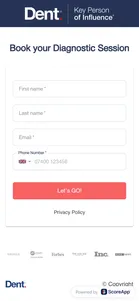
- Dent Global — “Book your Diagnostic Session”The 15-minute call both the KPI scorecard and 24 Assets offer. A plain form, name, email and a required phone number, with a coral “Let’s GO!” button and the press logos underneath. The phone the scorecard left optional is required here, once the visitor has asked for a call. Not submitted.View asset →
- The Diary Of A CEO — The 1% Diary, £35“Created by Steven Bartlett · 1.5M+ 1% improvements created globally.” A 90-day undated diary in four colours. Below the buy box: a video of him on “the power of the 1%”, the pages inside, a “problem with other diaries” comparison, a community strip, 47 reviews (4.91), FAQs and a “You may also like” row of two £25 Conversation Cards decks.View asset →
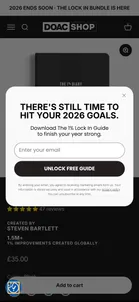
- The Diary Of A CEO — The 1% Lock In Bundle, £42 “save 42%”Pushed from the announcement bar on every page: “2026 ends soon · The Lock In bundle is here.” A value stack: the diary (£35), a pen (£12), a Notion goal tracker (£20) and the Lock-In Guide PDF (£5), “total value £72”, yours for £42. Three of the four items are “included free”, and two of those are digital, so the discount is mostly made of things that cost nothing to ship. A deadline (the end of 2026) on an undated 90-day diary.View asset →
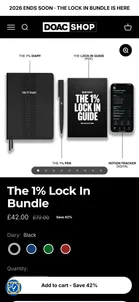
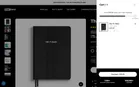
- The Diary Of A CEO — “You’re £15.00 away from free shipping”The cart drawer opens on add-to-cart with a progress bar to free shipping at £50. One diary is £35, so the cheapest way over the line is a £25 deck of cards, the same two products the diary page suggests. Under the checkout button: “3.5M+ conversations sparked worldwide” and “100,000+ sold globally”.View asset →
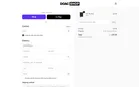
- The Diary Of A CEO — Shopify checkoutShop Pay and Google Pay at the top, then contact and delivery. The email field says it is “used for your order confirmation and cart reminders” and “Email me with news and offers” is ticked by default, so a visitor who types an email and leaves is still a lead. Card fields are on the same page; the capture stopped here.View asset →
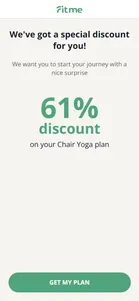
- FitMe — Special-discount interstitialAn urgency beat inserted between the lead capture and the price — "we've got a special discount for you!" primes the pricing about to be revealed so it lands as a deal rather than a cost.View asset →
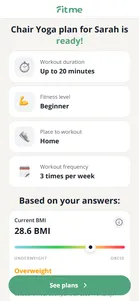
- FitMe — Subscription paywallThe paywall. "Chair Yoga plan for Sarah is ready!" recaps the tailored plan (duration, beginner level, at-home, the computed BMI) to justify the price, then reveals subscription options behind a card form. This is the payment gate — capture stops here.View asset →
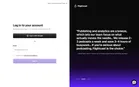
- Flightcast — /pricing goes to a login screenThe homepage menu links to Pricing, and the page is a login: “Don’t have an account? Sign up.” The FAQ mentions plan limits and annual discounts, but no price is visible without an account.View asset →
- Hampton — Vetting and the Commitment Call (not captured)TODO: capture. The application was not submitted. Hampton's own pages describe what follows: a vetting call for anyone who fits "on paper", a veto round in which current members can block an applicant, approval by "Sam and Joe", and then payment, with a refundable deposit, annual dues and a non-refundable initiation fee. The 45-day money-back guarantee only applies to members who "attended their Commitment Call". The price is never stated. The FAQ answers "How much does it cost?" with "an annual investment that many of our members deduct as a business expense."View asset →
- Hampton — After "Apply" (not captured)TODO: capture. The quiz was not submitted, so the first screen after it is unknown. The landing page spells out what follows: "We manually vet, research, and interview everyone who joins Hampton. Less than 8% of applicants are accepted." Anyone who looks like a fit "on paper" gets a vetting call ("This isn't a sales pitch"). After that comes a Community Veto, where current members can block an applicant, then a review by "Hampton founders Sam and Joe", then an invite: "Once you've paid your dues, you'll get immediate access." Core placement follows "within 90 days". The same page gives the members' average revenue as $15M; the live city ads say $25m.View asset →
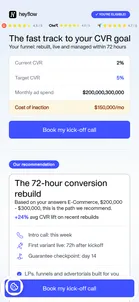
- Heyflow — Personalized eligibility recapThe payoff screen, and the funnel's strongest mechanic: a stat table that reflects the visitor's own answers back (current CVR 2%, target 5%) and then multiplies the gap into "Cost of inaction: $150,000/mo", set in warning amber directly above the booking CTA. Loss aversion computed from self-reported numbers is harder to dismiss than any claim Heyflow could make about itself. Below: a recommendation card, three client case mockups with named lifts, and a 30-day money-back guarantee. One visible bug — monthly ad spend prints as "$200,000,300,000", the range concatenated without its separator, though the same value renders correctly two blocks lower.View asset →
- Heyflow — HubSpot booking + "Meeting confirmed" (not captured)TODO: capture — the HubSpot meetings widget (meetings-eu1.hubspot.com/bohnenkamp/72-hours-offer) and the "✅ Meeting confirmed!" screen behind it. Both are present in the flow's DOM on first load but only render after a real submission, which would register a live lead on Heyflow's system and, via the bundled consent, subscribe to their newsletter. Worth capturing partly to check the calendar actually has slots — the Acquisition.com capture dead-ended on exactly that, and this funnel makes the same "intro call: this week" promise.View asset →
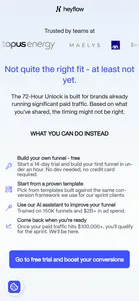
- Heyflow — "Not quite the right fit — at least not yet"The screen most funnels do not bother to build. Sub-$100k spend does not hit a dead end or a bare "you don't qualify" — it gets a downsell to the self-serve product (14-day trial, no card), two more soft options, and an explicit re-qualification threshold: "Once your paid traffic hits $100,000+, you'll qualify for the sprint. We'll be here." Rejection is converted into a product signup now and a pipeline entry later, and the CTA leaves for app.heyflow.com/signup with utm_source=fbig attached.View asset →
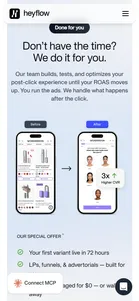
- Heyflow — "Don't have the time? We do it for you."The 72-hour sprint offer surfaced inside the product homepage, sold with a before/after mockup of a client PDP rebuilt as a quiz and a "3x Higher CVR" callout. Notably it routes to the contact-sales flow, not to the dedicated get.heyflow.site/72-hour-unlock page the ads use — the same offer with two different capture mechanisms depending on where you met it. An asterisk footnote discloses the $100K spend floor that the ad-driven version enforces with a quiz.View asset →
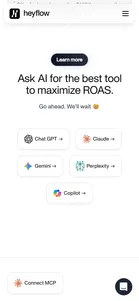
- Heyflow — "Ask AI for the best tool to maximize ROAS"Five buttons deep-linking to ChatGPT, Claude, Gemini, Perplexity and Copilot under the line "Go ahead. We'll wait 😉". Three carry pre-filled favourable queries; the Claude button opens a pre-baked shared conversation rather than a live prompt — a curated transcript presented as an impartial third-party verdict. Third-party AI recruited as on-page social proof, and the contact-sales form completes the loop by listing "AI Chat" as a "how did you hear about us" option.View asset →
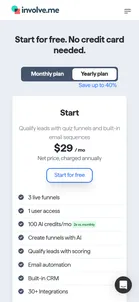
- involve.me — Pricing (Start $29 · Grow $69 · Scale $139 · Enterprise from $499)Yearly billing is picked for you ("Save up to 40%"), and every plan's button still says "Start for free". The free plan itself only gets a mention near the bottom. Two details stand out. Removing the "Made with involve.me" badge, which advertises involve.me on every customer's funnel, needs the $69 plan. So does tracking which ad a lead came from, which is exactly what involve.me does to its own visitors.View asset →
- involve.me — Book a call or get a quote (not captured)TODO: capture. The last screen is either "Thank you, please book a call below" with a calendar, or "A sales rep will be in touch with a custom quote". Seeing it means sending a real enterprise request, so it wasn't captured.View asset →
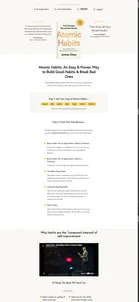
- James Clear — Atomic Habits (book)A full direct-response page — bestseller badges, two rounds of celebrity testimonials, a 60+-language international-editions table — with no on-site checkout at all. The real hook is "Claim Your Free Bonuses": forward any retailer's purchase receipt for 5 bonuses, including its own 5-email course.View asset →
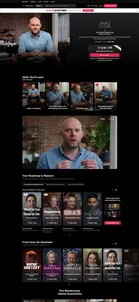
- James Clear — MasterClassUses Clear as the entry point to sell the whole MasterClass platform (200+ other instructors), complete with its own B2B upsell and its own separate opt-in. The only one of the four branches with a real on-site checkout.View asset →
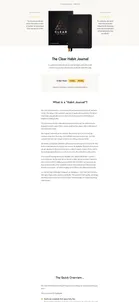
- James Clear — The Clear Habit JournalSame outbound-only pattern as the book (Amazon, plus manufacturer Baronfig) — but ships internationally to 60+ countries, wider reach than the book's US-centric retailer list.View asset →
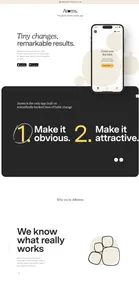
- James Clear — Atoms appA mobile-app marketing page, not a sales page in the usual sense — App Store/Google Play links only, no pricing table. The subscription sale itself happens inside the app after download.View asset →
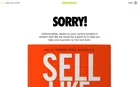
- King Kong — "SORRY!" rejection, downsold into the bookReached on a desktop viewport in this capture (the mobile walk stopped at question 4 — see the quiz step's note). Answering the revenue questions at $0 ends the quiz here: "Unfortunately, based on your current position it doesn't look like we would be a good fit... We suggest you check out Sabri's book 'Sell Like Crazy'." The "GET THE BOOK" button goes straight to `selllikecrazybook.com/free/` — the same free-book funnel captured separately as its own card. The two funnels aren't just run by the same person; one is a real, coded fallback destination for leads the other funnel rejects.View asset →
- King Kong — Strategy call (not reached)TODO: capture. Not reached: the details form before it asks for a mobile number and none was entered. What the calendar screen looks like is unknown from this capture.View asset →
- Marketing Secrets — 14-day trial sign-up (not captured)TODO: capture. Every button on the page starts the free trial, which takes a card and becomes $97 a month.View asset →
- NP Digital — Strategy call (not captured)TODO: capture. Submitting the form presumably books a call or hands off to a scheduling page. Not submitted (real PII, no reason to register as a lead for an agency pitch).View asset →
- Peterson Academy — “5 Reasons Why 64,029 Students Have Already Joined”The page most of the ads point at (159 found). A listicle with five numbered reasons (110+ courses, professors from MIT, Harvard and Oxford, a community, mobile, and a 7-day money-back guarantee), then a single price card: $500 a year, “less than the cost of a single college class”. No nav, three “Join the Academy” buttons, each tagged for the checkout (from=listicle-hero, landing-enrollment-card, listicle-footer). The headline number is live: it read 64,029 on the first visit and 64,021 an hour later, so it counts current members and falls as people leave.View asset →

- Peterson Academy — “Every serious thinker had to confront this book.”A long sales letter for the biblical courses aimed at a secular reader: Nietzsche, Jung and Dostoevsky were all arguing with the Bible, so “this isn’t about faith. It’s about literacy.” Five numbered reasons, faculty cards (Orr, Peterson, Barron), quotes from Steven Bartlett and Bill Maher, student reviews, then the plan picker right on the page, “$1.36 a day”. Each plan button opens the checkout with that plan already chosen.View asset →

- Peterson Academy — “Real Marxism has never been tried.”Built for one ad and styled like a Soviet poster: a red bar (“2 new courses · 15 hours on communism”), the ad’s first line repeated as the headline, trailers for the two courses, the two professors, and “Three reasons to enroll”. The ad and the page say the same thing in the same words, so the click doesn’t feel like a change of subject.View asset →

- Peterson Academy — “Why 64,023 People Decided Their Mind Was Worth Investing In”The page behind the partnership ads from comedians and outside professors. Their followers don’t know the Academy, so it leads with other students: numbered arguments, each backed by a named student review (“Will F.”, “Mark M.”). It ends at the same price card as the listicle.View asset →

- Peterson Academy — “Complete your enrollment”One page for every door: three plans on the left, the email, billing address and card on the right. $500 a year, $900 for two years (“Save $100”), or $5,000 once for life, with a “Lifetime badge beside your profile name”. The stats row above the plans counts “3,679 lifetime students”, which shows the $5,000 option already has buyers. Every visitor also gets a pricing-test cookie (`pa_pricing_bucket`); all four test visitors were in “control”.View asset →

- Prime Mover — Shipping payment and upsells (not captured)TODO: capture. "Send my book" leads to the shipping payment. In this style of funnel that is where the order bump and one-time offers usually sit, but they were not reached without paying.View asset →
- Prime Mover — "Stolen science: get them to pay you, even without proof"A short page around an autoplaying video: "The Mind Control Secrets That Manipulated Millions… (And How You Can Ethically Use 'Propaganda' To Get Rich!)". Above the headline is a banner: "WARNING: Due To Potential Censorship, This Video May Be Pulled Down As Soon As September 24th". The date comes from the page's own script, which takes today's date and adds one day, so every visitor on every day is told the video disappears tomorrow. The whole page is two claims of forbidden knowledge (stolen science, censorship) and a button to unmute.View asset →

- Prime Mover — What the video sells (not captured)TODO: capture. There is no offer, price or button on the page until the video has played.View asset →
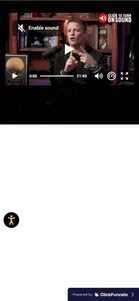
- Prime Mover — Prime Mover video sales lettersellingonline.com was a live three-day "Selling Online Challenge" with a $100 one-time ticket, advertised from Brunson's page through the end of 2025. A plain request for the domain still gets that page's title, but a browser gets redirected in script to primemover.com/pmvsl-watch. That page is nothing except a 21:40 video and an "Enable sound" button: no headline, no copy, no button. Everything is in the video. The old challenge domain has become a door into the holding company's own offer.View asset →
- Prime Mover — What the video sells (not captured)TODO: capture. The page shows nothing until the video plays, so the offer and its button are presumably revealed partway through. The Prime Mover site's main action is "Request Strategy Session", which suggests a call.View asset →
- Sabri Suby — Shipping checkout, order bumps (not captured)TODO: capture. A free-plus-shipping book funnel's real revenue is almost always in the checkout's order bumps and post-purchase upsells, not the free book itself. Not submitted (real shipping address and card details required).View asset →
- Salesforce — TODO: the report download and the follow-upNot captured yet: what “Download the report” produces, and what follows the lead (emails, a call). No form was submitted.View asset →
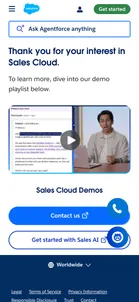
- Salesforce — “Thank you for your interest in Sales Cloud.”The Blueprint’s link (/form/conf/sales/agentforce-for-sales-demos/?leadcreated=true) skips the demos form and lands on its confirmation page: a thank-you for a form the reader never filled in, a demo playlist, and two buttons, “Contact us” and “Get started with Sales AI”. Floating call and chat buttons sit over them. The same demos reached from the website go through the eight-field gate first.View asset →
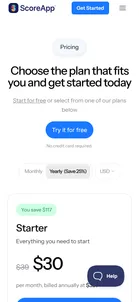
- ScoreApp — Pricing, with "Find my plan"Starter $39, Business $99, Pro $149 and Enterprise from $799 a month, with 25% off yearly. "Try it for free" leads to the same sign-up, and for the undecided there is "Not sure which plan is right for you? … Find my plan", which opens the diagnostic. Facebook pixel and Google Analytics tracking are a Business feature, so the tracking ScoreApp's own funnel relies on starts at the $99 tier.View asset →
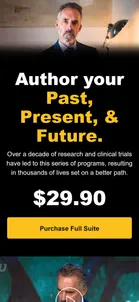
- Self Authoring — “Author your Past, Present, & Future.” – $29.90Peterson’s photo, the headline, and the price under it, $29.90, with “Purchase Full Suite”. The proof is research: “over a decade of research and clinical trials”, “Join 350,000 students worldwide”, “co-created by Dr. Jordan B Peterson”. Further down, each of the three programs is listed with its own price, $14.95.View asset →
- Self Authoring — “Self Authoring 2 for 1”“Purchase Full Suite” opens a modal for a different-sounding product: “Self Authoring 2 for 1. When you buy the Self Authoring 2 for 1 Special, you will receive all the Self Authoring exercises for yourself. You will also receive a voucher that you can email to a friend.” Same price, $29.90. The gift is in the headline offer, and the page doesn’t mention it.View asset →
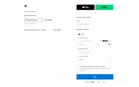
- Self Authoring — Stripe Checkout: “Pay ExamCorp, Inc.”“Self Authoring Suite 2 for 1 Special”, $29.90, on Stripe’s hosted checkout, under the same merchant as Understand Myself. The capture stopped at the card fields.View asset →
- Tony Robbins — Shipping payment and what follows it (not captured)TODO: capture. The order form opens from any button on the page, so the shipping price and any order bump are one click away. The one-time offers after payment, if there are any, were not reached without paying.View asset →
- Tony Robbins — The free strategy session (not captured)TODO: capture. The form leads to a real sales call, so it was not submitted.View asset →
- Tony Robbins — The application (not captured)TODO: capture. The application presumably leads to an enrolment call where the ticket is priced. Not submitted.View asset →
- Tony Robbins — Ticket options, after the form (not captured)TODO: capture. Submitting the form presumably reveals the ticket tiers, or starts a sales call. Not submitted.View asset →
- Tony Robbins — Zoom registration and the workshop (not captured)TODO: capture. The Zoom registration and the workshop itself, where the offer is presumably business coaching or Business Mastery, weren't attended.View asset →
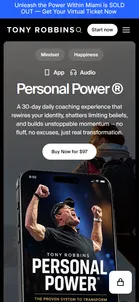
- Tony Robbins — "Personal Power®"The only live Robbins ad that doesn't go to a go.tonyrobbins.com landing page. It opens on the shop's ordinary product page ("Buy Now for $97"), with the full site navigation above it (programs, events, coaching, shop) and every exit that comes with it. The shop's own top bar is advertising the next funnel: "Unleash the Power Within Miami is SOLD OUT! — Get Your Virtual Ticket Now". The product is the "commemorative 30th Anniversary Edition", to be listened to one session a day for 30 days, and the page ends with an FAQ ("Why has Personal Power remained one of Tony Robbins' most popular programs for decades?").View asset →
- Tony Robbins — Cart and checkout (not captured)TODO: capture. Add to cart and the shop checkout weren't walked.View asset →
- Tony Robbins — The complimentary strategy session (not captured)TODO: capture. The form leads to a real sales call, so it was not submitted.View asset →
- Tony Robbins — The complimentary session (not captured)TODO: capture. Submitting the form books a real sales call with a coach. It needs a human decision before anyone walks it.View asset →
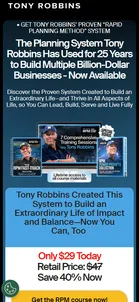
- Tony Robbins — "The Planning System Tony Robbins Has Used for 25 Years to Build Multiple Billion-Dollar Businesses"The cheapest paid offer on the page: "Only $29 Today", from a "$47" retail price, with a 30-day money-back guarantee. The letter sets RPM against to-do lists ("You Weren't Born to Chase To-Do Lists") and boils it down to three questions: what do I want, why, and how. The checkout isn't a separate page. The order form is built into the sales page, and every button ("YES! GIVE ME IMMEDIATE ACCESS FOR ONLY $29!") scrolls down to it. Two order bumps sit under the $29 line: the "Success Focus Kit" for $39 (a 230-page journal plus a Belief Busting Workshop) and "4 of Tony's Most Popular Coaching Sessions" for $77. So the $29 cart can reach $145 before the card is entered. The package also includes a "Complimentary Pathway to Power Strategy Session", which is the coaching funnel's free session, handed to every buyer.View asset →
- Tony Robbins — After the $29 payment (not captured)TODO: capture. Anything offered after payment, and whether the bundled strategy session is booked automatically, wasn't seen without paying.View asset →
- Tony Robbins — "You Already Know What To Do. So Why Aren't You Doing It?"The shortest of the program pages. The hook is that the problem "isn't information — the problem is conditioning", and Ultimate Edge is the fix: "Get Ultimate Edge today for just $247 $97 (60% OFF!)". It's sold as a three-part system delivered through the Tony Robbins app ("Transform Yourself While Driving, Exercising, Or On Your Lunch Break!"), with celebrity testimonials from Serena Williams, Conor McGregor, Maria Menounos and Marc Benioff. The order form is the same embedded widget as the other $97 programs. Ultimate Edge is also bundled into the Executive, VIP and Diamond UPW tickets ($1,495 and up), so the "best selling program of all time" is sold here for $97 and included free with the higher event tickets.View asset →

- Tony Robbins — "Build a love that stays deeply connected, passionate, and alive over time""Only $97 Today", against a "$249 Value", for "a 10-day audio experience you can start today". The opening testimonials are the strongest on the whole site ("Three days in, I canceled my divorce."). The letter's case is the one the Relationship Coaching page makes: "Every relationship runs on one. A pattern." The order form is an embedded tonyrobbins.com widget, the same one the book, Ultimate Edge, Unshakeable and UPW pages use, and it carries two bumps under "Special offer when you add to your order now". The first is **Tony Robbins AI at $39/month**, a subscription added to a one-off purchase with a line granting permission "to charge your card for future payments". The second is a $77 "Personal Coaching Collection" of six sessions. The RPM checkout sells what looks like the same $77 collection as four sessions.View asset →

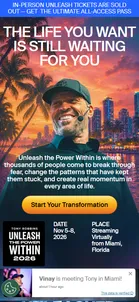
- Tony Robbins — "The Life You Want Is Still Waiting for You"Unleash the Power Within, November 5–8 2026, "Streaming Virtually from Miami, Florida". The top bar sells the new product: "IN-PERSON UNLEASH TICKETS ARE SOLD OUT — GET THE ULTIMATE ALL-ACCESS PASS". That pass is the only ticket you can buy: "Retail Price: $695, $200 OFF, BUY NOW: $495", with a front-row POV camera, backstage access and an at-home board break. Beside it, the four in-person tiers are still laid out in full, each stamped SOLD OUT: General, Executive ($1,495, with the Ultimate Edge program), VIP ($1,995) and Diamond ($3,995). They're there as proof of demand and as a price anchor. The page leans on a Stanford-co-authored study ("~300% improved cognitive capacity"), and on mobile a toast in the corner reports "Vinay is meeting Tony in Miami! about 59 minutes ago · This data is verified", for an event whose seats are gone. A Calendly "book a call" section near the end catches anyone who wants to talk first.View asset →
- Tony Robbins — Virtual pass checkout (not captured)TODO: capture. The order form is the embedded tonyrobbins.com widget, and the upgrades offered during or after checkout weren't seen. Nor was the coupon, since the pop-up form wasn't submitted.View asset →
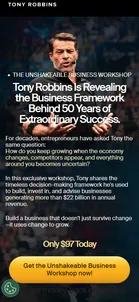
- Tony Robbins — "Tony Robbins Is Teaching the Exact Decision-Making Framework He's Used to Build Over 120 Businesses Worth $22 Billion.""Only $97 Today", against a "$197 Value", for a recorded workshop on Tony's "8-trigger" framework for anticipating market shifts. It is open about its place in the ladder: "For decades, entrepreneurs have paid thousands of dollars to learn directly from Tony at Business Mastery. The Unshakeable Business Workshop is Tony's opportunity to make the core principles… available to every entrepreneur—at a fraction of the cost." The page is RPM's template with the product changed, and the swap is incomplete. The P.S. still asks "Are you ready to stop managing your time and start designing your life?" and invites you to "Join the thousands who have transformed their productivity… with Unshakeable Business today", and the Terms link goes to /rpm-terms. The FAQ calls it "recorded during a one-time event… available for a limited time", on ads that have run since April.View asset →
- Tony Robbins — After the $97 payment (not captured)TODO: capture. Whether buyers are offered Business Mastery straight after payment wasn't seen without paying.View asset →
- Ubersuggest — Plans & PricingIndividual $6.67/mo, Business $10.42/mo, Enterprise $22.58/mo (all annual, "5 months free" from this page's own countdown offer), plus a custom agency tier. Neil Patel's own photo sits next to the plans: "Neil Patel, Co-Founder at Neil Patel Digital."View asset →
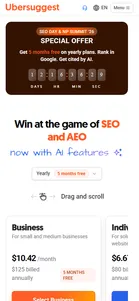
- Ubersuggest — "Win at the game of SEO and AEO"A full sales page, not the plain pricing list — a competitor price-comparison chart (Ubersuggest vs SEMrush/Ahrefs/Moz), trust-logo strip, testimonials, a feature-by-feature comparison table and an FAQ, with Neil Patel's photo next to the plans. Its own banner offers "2 months free", not the "5 months free" the plain pricing page (reached via nav from the other four tools) offers for the same plans on the same day — two live discounts for one product.View asset →
- Understand Myself — “The most comprehensive & accurate personality test”One product, one page: Peterson’s photo, the claim, and two buttons repeated six times down the page, “Buy Now – $9.95” and “Package for 2 – $19.90”. Proof is research rather than reviews: the Big Five Aspects Scale, a sample of 10,000 people, “over 600,000 tests completed worldwide”, and his Harvard and Toronto history. Near the bottom it warns that each person can take the test only once.View asset →

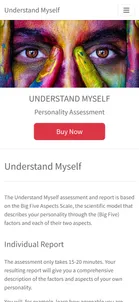
- Understand Myself — The homepage: individual, couple, voucherWhere the bit.ly link lands. Instead of a sales letter, a product menu: “Just for Me” at $9.95, “For My Partner and Me” at $19.90 (an assessment plus a voucher), and vouchers for people who have already taken the test. The relationship report is explained here: both partners take the test, then connect their results.View asset →
- Understand Myself — “Individual Assessment – $9.95”Every Buy button opens the same modal: the product (switchable from a dropdown), its price, a coupon link, and “Pay with Card” or PayPal. Even the single test mentions the partner: “If your romantic partner has completed their own assessment, you can connect them to create a relationship report.”View asset →
- Understand Myself — Stripe Checkout: “Pay Examcorp”Card payment is Stripe’s hosted page, priced in the visitor’s local currency with dollars as an option. The merchant name is “Examcorp”, the company behind both Understand Myself and the Self Authoring Suite. Peterson’s name doesn’t appear. The capture stopped at the card fields.View asset →
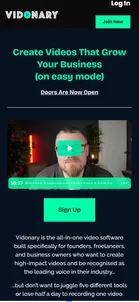
- Vidonary — “Create Videos That Grow Your Business (on easy mode)”A long sales page: “We bet you’re bloody brilliant at what you do, but it’s time more people knew about it.” It shows the app feature by feature (plan, record, edit, publish), adds a Green Room community and a Video Bootcamp, and repeats the plan table three times down the page.View asset →
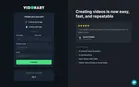
- Vidonary — Create your accountGoogle, Apple or email sign-up. The one quote beside the form is Priestley’s: “The scripts inside this app have helped me generate over 10 Million views.” The ad said 5 million a month; the sign-up page says 10 million. Not completed, so the plan and payment screens were not seen.View asset →