Opt-in/lead form examples
Real-world Opt-in/lead form examples pulled from complete funnels, each in the context that makes it work.
32 examples
- Acquisition.com — "5 Scaling Frameworks" lead formA HubSpot form that goes far past name and email — annual revenue, ownership structure, industry, and how long you have known Alex, all before a free download. It is not just segmentation for the nurture sequence: one of those answers picks the next page. Answer under $100k and the funnel stops selling to you entirely. Answer anything else and you land on a workshop pitch. The visitor is sorted at the moment of opt-in and never sees the branch they did not get.View asset →


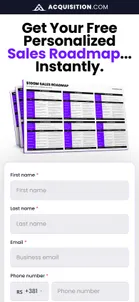
- Acquisition.com — Sales Roadmap form (one page)"Get your free personalized Sales Roadmap… instantly." Unlike the main Roadmap, which goes a screen at a time, this is a single long form: first and last name, business email, phone with a country-code picker, and four dropdowns (annual revenue, ownership, how long you have followed Alex, industry), over a mock-up of the "$100M Sales Roadmap, six stages, one constraint at a time". The button is DOWNLOAD NOW. /sales-roadmap-b is the same form under the title "Sales Roadmap B", so two URLs are being run against each other. The country-code picker defaults to the visitor's country, and the phone number is validated: an invented US number is rejected.View asset →
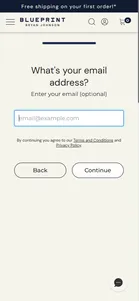
- Blueprint — Email capture — optionalThe funnel's only lead capture, and its weakest moment. It is labelled "(optional)", and its Continue button is rendered as an outline button identical to Back — the only screen in the flow without a solid primary CTA, on a flow where every other screen advanced on a single tap. The visitor has just answered eleven questions and is one tap from the payoff; the path of least resistance is to skip. This is the whole handoff problem in one screen: an eleven-question profile is about to be spent on a basket and then discarded.View asset →
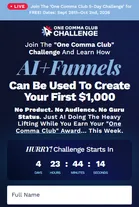
- ClickFunnels — Challenge registration formFull name, email, and an optional phone number under the line "Get important challenge notifications so you don't miss a thing." The consent text underneath covers automated calls, texts and "prerecorded/artificial voice messages" for "promotional outreach", so the optional phone number is a sales channel as well as a reminder. Nothing is qualified here. Everyone who registers gets the same next page.View asset →
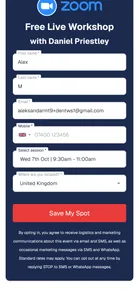
- Dent Global — Registration form, mobile number requiredFirst name, last name, email, session, location, and a required mobile number. The consent line covers "logistics and marketing communications about this event via email and SMS, as well as occasional marketing messages via SMS and WhatsApp". The recorded masterclass forms ask for the same mobile number. Nothing on the form asks about revenue, so the "not for anyone under £100k" line on the page is a request, not a filter.View asset →
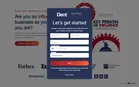
- Dent Global — Contact form before the first question“Let’s get started”: first name, last name, email, an optional phone number and a country, before a single question has been asked. Most ScoreApp quizzes ask for contact details at the end, once the visitor wants their result. This one asks first, so it gets the email even from people who drop out halfway. The fine print says the report comes “along with relevant business tips and events”. Unlike every Dent workshop form, the phone number is optional.View asset →
- Dent Global — 24 Assets contact form“Enter your details below to start the scorecard”: name, email and location, with no phone field at all. As on the KPI scorecard, the form comes before the questions.View asset →
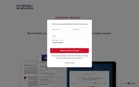
- The Diary Of A CEO — “Where should we send your guide?”“Send me the guide” opens a Klaviyo modal with one field. Email only, no name, so the cost of saying yes is as low as it gets. The questions come on the next two screens, after the address is already saved.View asset →
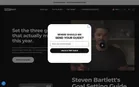
- The Diary Of A CEO — TODO: the Facebook instant formNot captured. Instant forms open only inside the Facebook app for a logged-in user, prefilled with that person’s details, so they can’t be reached from the Ad Library. To capture: open either ad on a phone with a Facebook account and screenshot the form.View asset →

- FitMe — Email + name lead captureThe PII gate. The personalized plan is dangled just behind an email field, then a marketing-consent tap and a first-name ask follow — the name is reused to personalize the paywall ("plan for Sarah"). The email input is a plain text field, so the gate is only recognizable from the heading, not the input type.View asset →

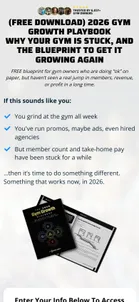
- Gym Launch — "2026 Gym Growth Playbook" download page"(FREE DOWNLOAD) 2026 GYM GROWTH PLAYBOOK: why your gym is stuck, and the blueprint to get it growing again." A HubSpot form beside the book cover: first name, last name, email, mobile phone and one qualifier, "Tell Us About Yourself", with eight options from "I am a Gym Owner" through "I am a personal trainer" to "I am not a Gym Owner, but I love what you do". The form carries a reCAPTCHA, which on the live page shows Google's test-key banner: "This reCAPTCHA is for testing purposes only. Please report to the site admin if you are seeing this." A scripted submit returned "Failed to validate Captcha", so nothing after the form is captured. A second, hidden form on the page posts to /playbook-26 with shipping and billing fields.View asset →
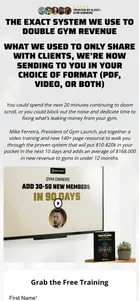
- Gym Launch — "The exact system we use to double gym revenue" training page"The exact system we use to double gym revenue. What we used to only share with clients, we're now sending to you in your choice of format (PDF, video, or both)." The body names Mike Ferreira, President of Gym Launch, and promises "$10-$20k in your pocket in the next 10 days" and "an average of $168,000 in new revenue to gyms in under 12 months", from a video training and a 140-plus-page resource. A video thumbnail ("add 30-50 new members in 90 days") sits above a "Grab the Free Training" form, whose fields include a three-way delivery preference. Like the Playbook page it carries a hidden second form with shipping and billing fields, posting to /double-v-copy. The form was not submitted.View asset →
- Hampton — "Net Worth Reveal: A rare look at the monthly expenses, income, and investing habits of 50 founders"The report is sold on its teasers: Alex Hormozi's "liquid ~$95–100M… spends ~$80–120K/month", Bryan Johnson, Scott Galloway, Loom's Vinay Hiremath "declined ~$60M earn-out", and an anonymous billionaire, "Oscar". "This document, because of its rarity, could costs thousands of dollars. But we decided to make it completely free." The price of free is a form that asks everything the membership application asks: role, annual revenue band (the same sub-$3M options), industry, company URL, country, zip code and a required phone number, with the same SMS opt-in. It's a membership application disguised as a download.View asset →

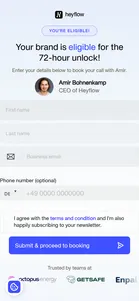
- Heyflow — Lead form ("Submit & proceed to booking")Four fields and a single checkbox, personalized with the CEO's name and face — you are booking with Amir Bohnenkamp, not "the team". Only the email is meaningfully gated ("Business email"); phone is explicitly optional, so the form asks for as little as the booking requires. The one checkbox bundles terms acceptance with newsletter subscription in a single tick, which for a German company under GDPR couples two consents that are meant to be granular.View asset →
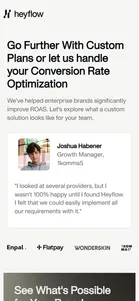
- Heyflow — Contact Sales flowThe sales-assisted exit, reached from "Book demo", "Book your sprint" and "Contact Sales" across all three entry pages — one flow, with the originating button tagged in the URL (?button=demo, ?button=enterprise_security). Fronted by a named testimonial and a client logo wall above the form. Also built in Heyflow, on Heyflow's own operations domain.View asset →
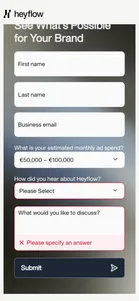
- Heyflow — Contact Sales form fieldsWhere this funnel's qualification actually lives — and it is far softer than the sprint offer's. Spend brackets are in euros and start at "Under €25,000", with an explicit "I don't spend money on paid advertising" option, so nobody is turned away. Two defects: the spend select is pre-answered at "€50,000 – €100,000" rather than defaulting to its own placeholder option, so any lead who skips the field is filed in a bracket they never claimed — on the field that drives routing; and a "Please specify an answer" validation error renders before the visitor has interacted with anything.View asset →
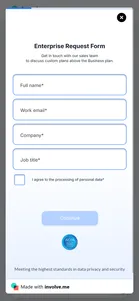
- involve.me — Enterprise request form (5 screens)"Contact sales" on the Enterprise plan opens a short quiz built with involve.me itself. It asks for your name, work email, company and job title, then what you'll use it for, then five numbers (users, monthly visits and so on). Finally it lets you choose: book a call or get a quote by email. Its first screen still mentions a "Business plan" that no longer exists.View asset →
- James Clear — Newsletter opt-inA single email field, nothing else — the destination matches the ad's promise exactly, no qualifying questions, no bait-and-switch.View asset →

- James Clear — "30 Days to Better Habits" course opt-in (not captured)TODO: capture — a second, real lead magnet (an 11-lesson free email course) offered on the same confirmation page. Not converted into this pass; would need a second persona/inbox to avoid conflating two welcome sequences.View asset →
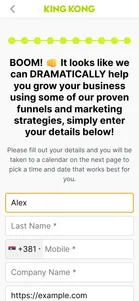
- King Kong — "BOOM!" details form, before the calendarReached on a phone after the Agency path's three extra questions. The headline congratulates the lead ("BOOM! It looks like we can DRAMATICALLY help you grow your business") and asks for details again: first name, last name, mobile number, company name and website, with the first name and website already filled from earlier answers. The number field defaults its country code to the visitor's detected location. The copy promises "a calendar on the next page to pick a time and date", so this is the last gate before the booking step. The phone number is the only new thing it asks for that the quiz has not already asked or implied, and it was not entered.View asset →
- NP Digital — Messenger click-to-chat (not captured)TODO: capture. fb.me opens a Messenger conversation rather than a webpage, so there's nothing to screenshot as a landing page — the "form" is whatever the chat bot or a human rep asks for. Not walked, since that requires an actual Messenger session rather than a browser capture.View asset →
- OfferLab — "The 47 second hack to have other people make you money online"A headline, a subhead ("…And It Even Works If You Don't Have A Product Or An Audience Or A Budget!") and a video thumbnail made to look like a press montage, with Brunson in the corner and a red "PRESS VIDEO" stamp. The video cannot be played until an email address is submitted, so the page is an opt-in gate, with no price and no navigation. The footer calls OfferLab "an Etison Product", the company behind ClickFunnels, and the copyright still reads 2025, a year after the launch ads stopped.View asset →

- OfferLab — After the video (not captured)TODO: capture. Whatever the video leads to, presumably an OfferLab sign-up, is not on the splash page itself.View asset →
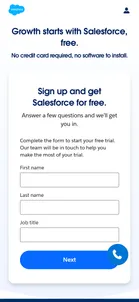
- Salesforce — “Sign up and get Salesforce for free.”The same three-step wizard as the Starter trial: name and job title, then company, size and country, then email and a required phone number. The page config files it as a “free-trial” offer (free-trial-00002633), and the small print is the trial’s, reused: “Your free trial may be provisioned on or migrated to Hyperforce” and “Our team will be in touch to help make the most of your experience.” One line is new: “Inactive accounts may be deleted after 60 days of no use”, a limit on “Free Forever”. Walked to step 3; not submitted (it needs a real phone number).View asset →
- Salesforce — The header’s “Get started”: a Starter trialThe green “Get started” in the header of the Free CRM page goes to a different sign-up altogether: a Trailblazer account page headed “Let’s get you into your Starter free trial.” It asks for “Business email” only, or “Continue with Google”, with no phone and no wizard, and it carries a reCAPTCHA. A Gmail address was accepted. So the quickest way to sign up from the free plan’s page is into the paid plan’s trial.View asset →
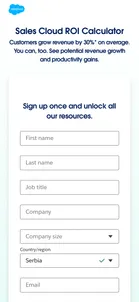
- Salesforce — The gate: the same eight fields“Sales Cloud ROI Calculator” and the form Salesforce uses on every gated offer: first and last name, job title, company, company size, country, email, phone, all required. After it, the form sends the visitor to a public confirmation page (/sales/conf/resources/sales-roi-calculator/), whose address is in this page’s source. Not submitted during capture; the calculator was opened at that address.View asset →
- Salesforce — Three steps, contact details last“Step 3 of 3” with a counter. Who you are, then where you are, then “Just one more thing”: email and phone, both required, and a box agreeing to the Main Services Agreement. Seven answers come before the two that cost the most. “Our team will be in touch to help you make the most of your trial”, so a trial is also a sales lead. Walked to step 3; not submitted (it needs a real phone number).View asset →
- Salesforce — Eight fields, phone requiredFirst name, last name, job title, company, company size, country, email, phone — all required. It is the same form, built from the same component, on every Salesforce gated offer: a report, a calculator or a three-minute demo video all cost the same eight answers. The country is filled in from the visitor’s location, and changing it changes the consent.View asset →
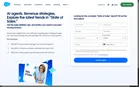
- Salesforce — The next report: the Agentic Sales Blueprint“Get the blueprint” on page 29 leads to another report behind the same eight-field form. The Blueprint is also advertised on its own (“Stop the grind. Start winning.”) and sent to existing contacts in Salesforce’s marketing email, as the cached page source shows (utm_source=marketing_email).View asset →

- ScoreApp — "Get the $1M Lead Gen System Blueprint" opt-in pageThe page leads with Priestley, not the product: "Daniel Priestley shows you: The step-by-step process used to generate high-quality leads", a video trailer, and "A 20-minute Masterclass" repeated under the headline. The form asks for three things, first name, last name and a business email. Below it come a strip of logos (the Great British Entrepreneur Awards, Ali Abdaal), four testimonials about learning from Priestley, and a short biography that names his other company, Dent Global. ScoreApp is not named until the fourth section, "Why ScoreApp is the super-effective marketing tool you need", where it is introduced as the tool the masterclass teaches. The page itself is a ScoreApp scorecard, so a visitor signing up to learn scorecard marketing is already using one.View asset →

- Tony Robbins — The application (not captured)TODO: capture. The application presumably leads to an enrolment call where the ticket is priced. Not submitted.View asset →
- Tony Robbins — Ticket options, after the form (not captured)TODO: capture. Submitting the form presumably reveals the ticket tiers, or starts a sales call. Not submitted.View asset →