Longevity Mix Subscription Page (Blueprint) — a Direct-to-product funnel teardown
ProductEcommerce
TypeDirect-to-product
CategoryLongevity & supplements
This is the same brand’s other funnel, and it is the mirror image of the Protocol Quiz: no questions, no gate, no lead capture anywhere. An ad lands on one long page, the page argues the category, and the buy box does the rest.
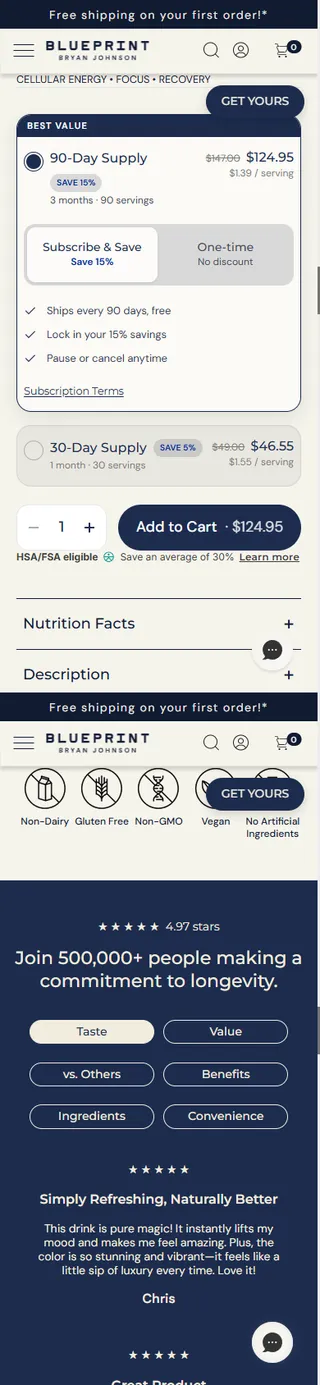
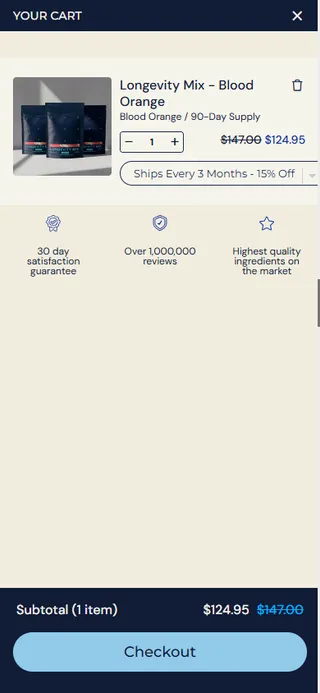
The mechanic is the price ladder, and it runs in an unexpected direction. Cold paid traffic is defaulted into a 90-day supply at $124.95 with 15% off, pre-selected and flagged BEST VALUE, with the per-serving cost printed underneath to make the comparison for you. The 30-day option sits below it at $46.55 with 5% off — which is precisely what the quiz funnel recommends to visitors who have already answered eleven questions on the site. The colder the audience, the deeper the discount.
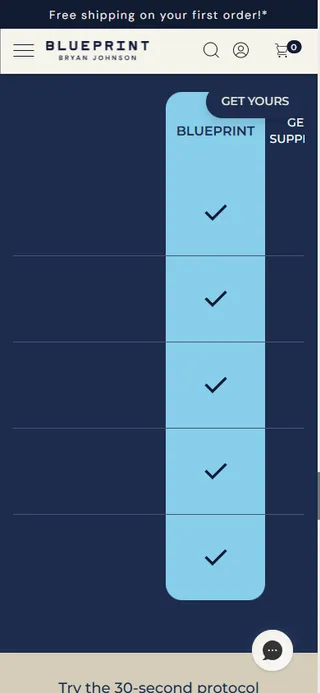
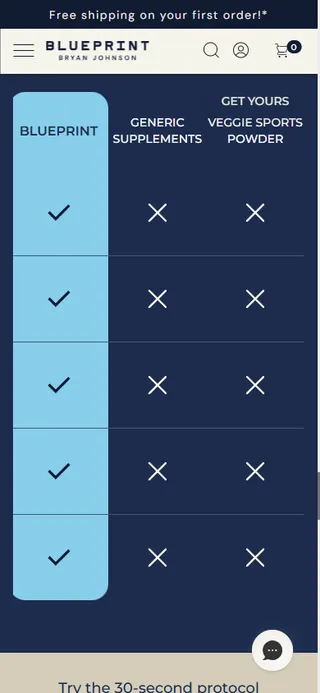
Two things are worth taking from it beyond the pricing. The proof is unusually concrete for the category — a thirteen-ingredient carousel that justifies each active individually, and a testing section that answers a specific fear with a specific number. And the comparison table, which should be the strongest objection-handler on the page, loses its row labels entirely on mobile, leaving a column of checkmarks compared against nothing on the only device the ads actually target.
There is no Capture stage at all. A visitor who arrives from the ad and does not buy leaves no trace, and nothing on the page — on a phone — offers them the quiz instead.
Funnel canvas — drag to pan, scroll or use the buttons to zoom. Each node links to that step's page.
All thirteen ads carry the same copy and run from the founder's personal page rather than a brand page, so the face arrives before the product. Only the format changes, which makes it a placement test rather than a creative test.
The buy box opens with the 90-day supply already chosen at $124.95 (15% off) and flagged BEST VALUE. Subscribe & Save is ticked, and the 30-day sits below at $46.55 unselected.
3
The page does the unit-cost math
Per-serving prices are printed under both options, $1.39 for the 90-day and $1.55 for the 30-day. The visitor never has to work out which is cheaper.
A carousel of thirteen actives gives every one a "Why we chose it" line, and a testing section answers "up to 90% of supplements are mislabeled" with a $600,000 testing spend. The 90-day commitment itself is never argued in the copy.
On a computer this funnel opens as a canvas: every page at full length, side by side, with the arrows between them and the moves that make it work. A phone screen can't hold it, so here it's a list.
All thirteen ads carry the same copy and run from the founder's personal page rather than a brand page, so the face arrives before the product. Only the format changes, which makes it a placement test rather than a creative test.
The buy box opens with the 90-day supply already chosen at $124.95 (15% off) and flagged BEST VALUE. Subscribe & Save is ticked, and the 30-day sits below at $46.55 unselected.
3
The page does the unit-cost math
Per-serving prices are printed under both options, $1.39 for the 90-day and $1.55 for the 30-day. The visitor never has to work out which is cheaper.
A carousel of thirteen actives gives every one a "Why we chose it" line, and a testing section answers "up to 90% of supplements are mislabeled" with a $600,000 testing spend. The 90-day commitment itself is never argued in the copy.