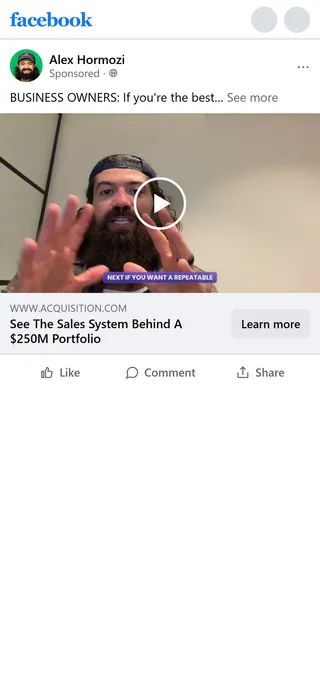
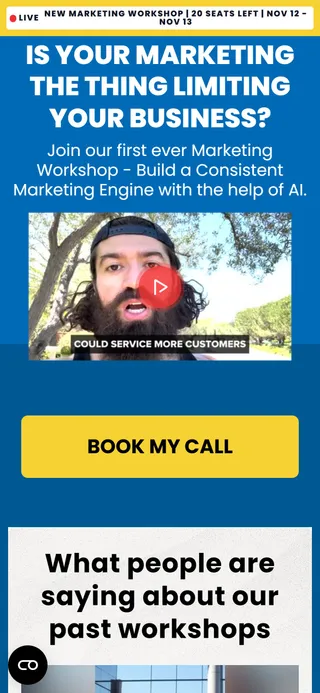
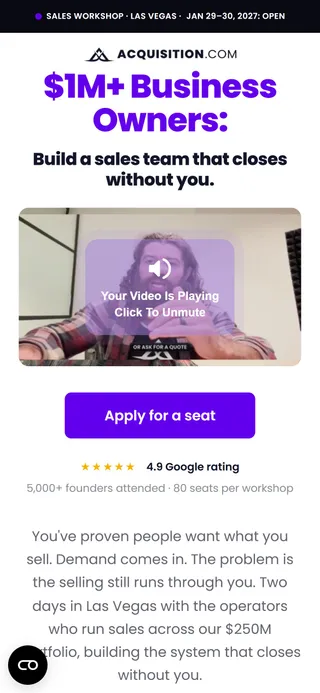
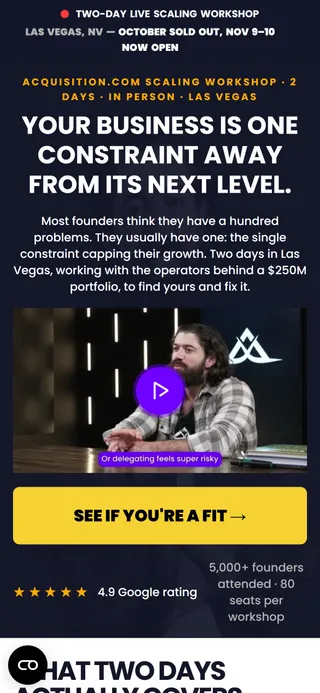
There are three workshops, Marketing, Sales and Scaling, and about ninety live ads send traffic to them. They are one funnel, because every page does the same job: a video and a button into a booking calendar. The nuances are in what each page changes.
The verb. Marketing says BOOK MY CALL, Sales says “Apply for a seat”, Scaling says “SEE IF YOU’RE A FIT”. Three levels of formality for the same calendar.
The audience. The Marketing and Sales ads both say “$1m+ a year” and the Sales page opens with “$1M+ Business Owners”. The Scaling ad names no revenue floor.
The scarcity. Each page names a cohort and states what has already gone, so the next date is always the last one open. The Sales ad says 90 seats and the page says 80.
The doubles. Sales is served from two hosts. The Scaling Workshop has two pages, /workshop-4b (also reached through /workshop) and /workshop-km, with different headlines, buttons and calendars, so the pages are being tested against each other.
Only the hero of each page was captured. The booking calendars sit behind a phone-number form and were not opened, and no lead was submitted. Dates, seat counts and ad counts are as of 2026-10-02.
Funnel canvas — drag to pan, scroll or use the buttons to zoom. Each node links to that step's page.
Each ad diagnoses a problem the founder owns, then asks the reader to book a call to see if it is a good fit. The Marketing and Sales ads add the "$1m+ a year" qualifier in the last line, so the ad screens before the page does.
Each page is a video, a headline that restates the ad, one button, a social-proof strip and a booking widget. Only the offer, the palette and the verb on the button change: BOOK MY CALL, Apply for a seat, SEE IF YOU'RE A FIT.
3
A calendar per page
Every page books into its own iClosed event, including the two pages for the same Scaling Workshop. A call booked can likely be traced to one landing page from the calendar alone.
4
Scarcity is a cohort, not a countdown
Each banner names dates and what has gone: 20 seats left for November 12–13, November and December sold out with January open, October sold out with November 9–10 open. Scarcity is stated in the past tense about earlier dates.
Retain
Attract
Sell+1
Made for a big screen
See all 7 steps as one map
On a computer this funnel opens as a canvas: every page at full length, side by side, with the arrows between them and the moves that make it work. A phone screen can't hold it, so here it's a list.
Each ad diagnoses a problem the founder owns, then asks the reader to book a call to see if it is a good fit. The Marketing and Sales ads add the "$1m+ a year" qualifier in the last line, so the ad screens before the page does.
Each page is a video, a headline that restates the ad, one button, a social-proof strip and a booking widget. Only the offer, the palette and the verb on the button change: BOOK MY CALL, Apply for a seat, SEE IF YOU'RE A FIT.
3
A calendar per page
Every page books into its own iClosed event, including the two pages for the same Scaling Workshop. A call booked can likely be traced to one landing page from the calendar alone.
4
Scarcity is a cohort, not a countdown
Each banner names dates and what has gone: 20 seats left for November 12–13, November and December sold out with January open, October sold out with November 9–10 open. Scarcity is stated in the past tense about earlier dates.